Thundr is one of the sites that picked up Omegle's crowd after Omegle closed. It used to live at thundr.tv and moved to thundr.com under the same owner, so if you see both names, it's one service. I spent an evening on it on 24 August 2026 and went through the paid stuff, the ban system and the Reddit complaints. This is what I found.
How you get in, and is there an app
Thundr wants an account. You either register with a nickname, password and gender, or sign in with Google or Apple. No email confirmation, no phone.
In 2026 they released an Android app on Google Play, and it already shows 100k+ downloads. There is no iPhone app, and as far as I understand there won't be one: Apple doesn't let random video chat apps into the App Store. On iPhone you use the website.
Two modes: text chat and video chat.
Coins, boosts and the daily crate
There's no monthly premium. Everything runs on coins.
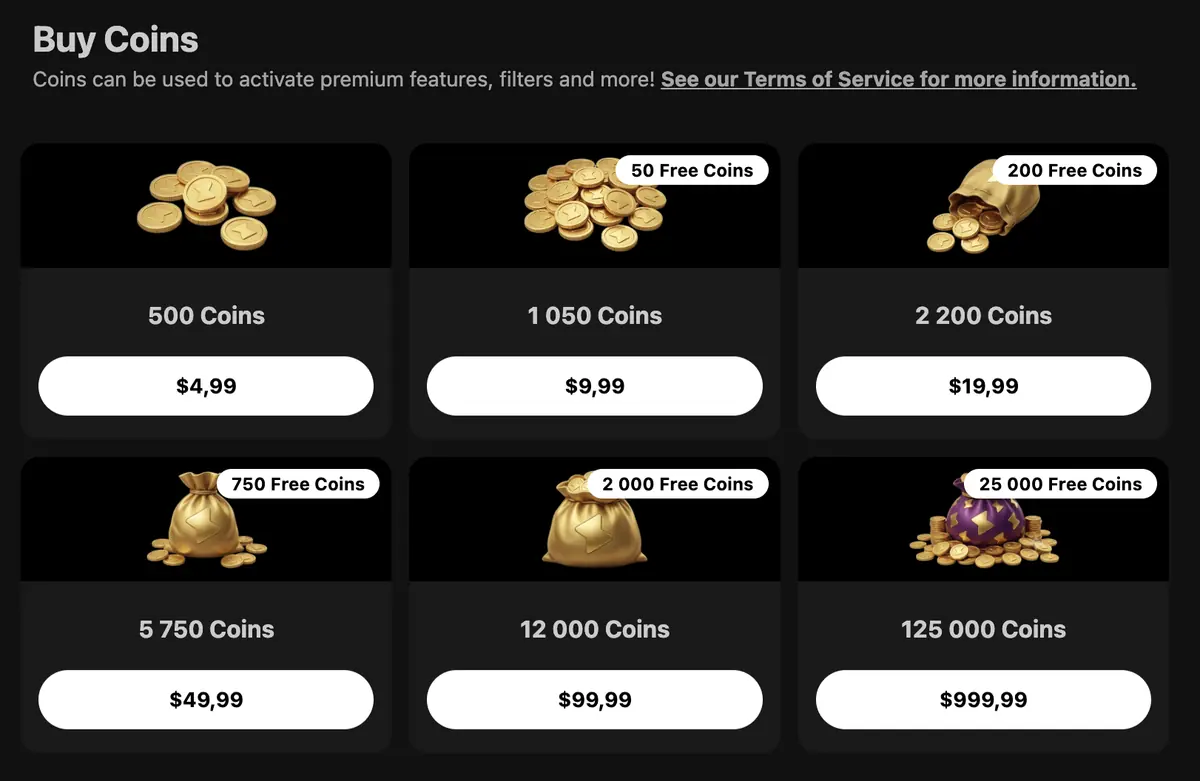
Coin packs at the time of my test:
- 500 coins: $4.99
- 1,050 coins: $9.99
- 2,200 coins: $19.99
- 5,750 coins: $49.99
- 12,000 coins: $99.99
- 125,000 coins: $999.99
What you spend coins on is a "Boost". The pitch on the boost screen says you'll match only with "the hottest people on Thundr". In practice it's the closest thing Thundr has to a gender filter: it raises your odds of being matched with women. It doesn't guarantee it.
- Small Boost, 10 minutes: 450 coins
- Normal Boost, 30 minutes: 1,000 coins
- Super Boost, 1 hour: 2,100 coins
- Hyper Boost, 5 hours: 7,900 coins
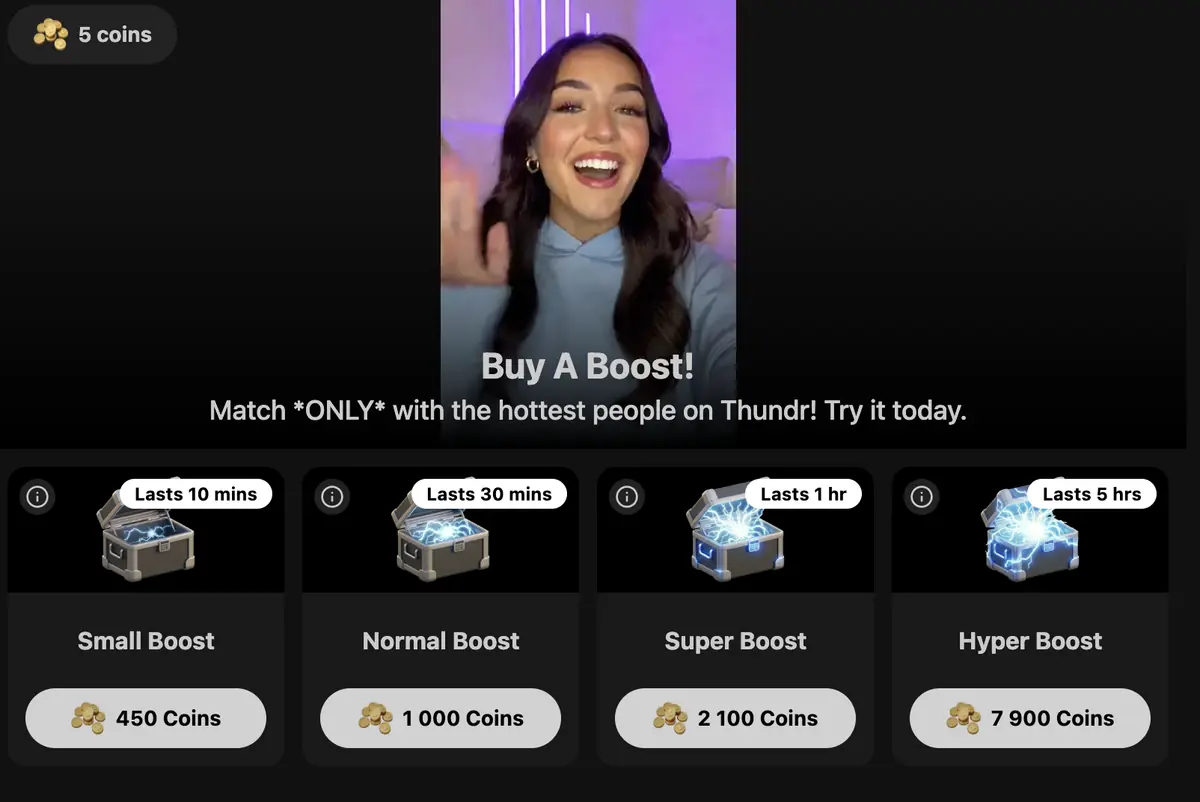
So the cheapest way to try a boost is the $4.99 pack, which gets you one 10-minute Small Boost with 50 coins left over. An hour of boosted matching is roughly $20.
There's a free route too, called the Daily Crate. You open a crate once a day, the streak goes up to seven, and every seventh crate is "boosted". The screen shows the possible rewards: 5+ coins minimum, 25+ if you're lucky, 250 jackpot.
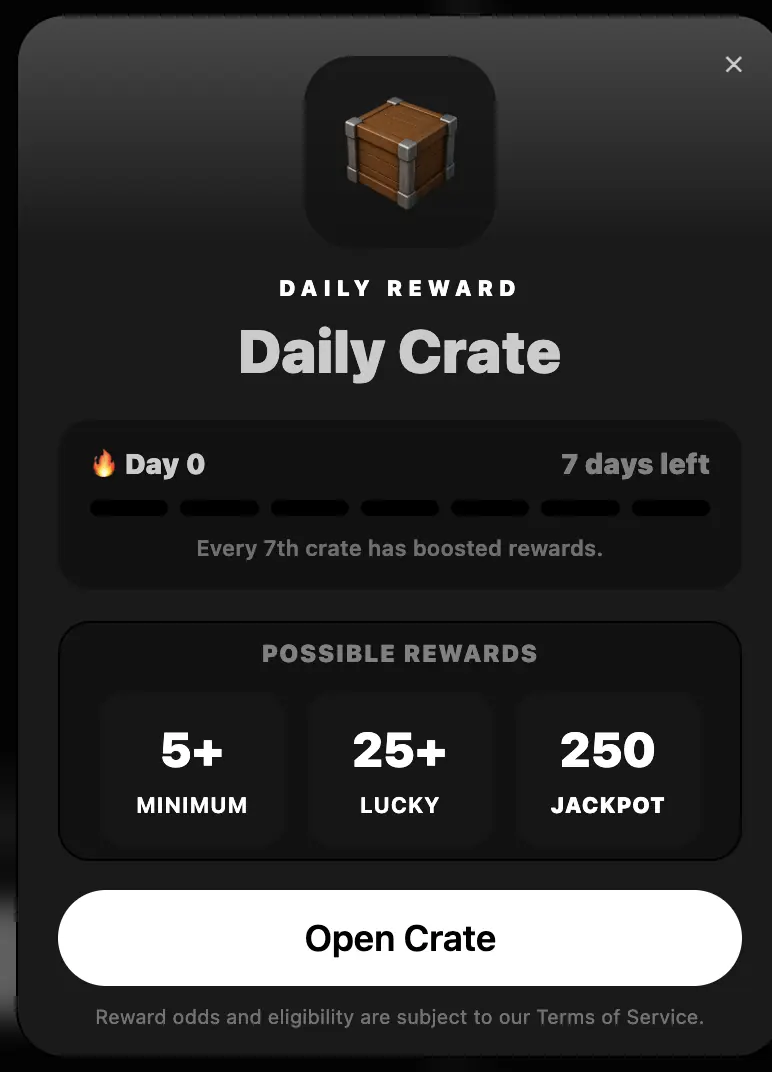
I did the math on the minimum. At 5 coins a day, a 10-minute Small Boost takes 90 days of logging in every single day. Three months for ten minutes. You'll do better than the minimum sometimes, but the design is clearly there to make you buy the pack.
The country filter, on the other hand, is free. No coins needed.
Bans: the normal kind and the hidden kind
Thundr has two kinds of bans.
The normal one is a ban screen. I didn't get one during my test, so I can't tell you how long it lasts or whether they sell an unban.
The hidden one is what people on Reddit call a shadow ban, and it's the thing Thundr is most known for. Nothing tells you it happened. The site works, the start button works, but the search for a partner takes much longer than usual and when it connects, it's bots. Recorded loops, people pushing an Instagram or Snapchat handle in the first seconds, nobody answering a hello. You've been moved to a separate pool.
Thundr doesn't publish what triggers it or how long it lasts. In my experience the most common trigger is a VPN: connect through one and the chance of landing in the bot pool goes up a lot. Other users also point at reports, fast skipping, virtual camera software and chatting without showing your face.
Bots, spam and NSFW
There are bots and there are spammers on Thundr, even outside the shadow ban pool. I didn't count them, but you'll meet some.
NSFW isn't banned, from what I could tell. It's sorted instead. If you're not doing anything explicit, you mostly get matched with people who aren't either. If you are, you get matched with people who are. That's a design choice, not moderation.
Matching speed, video quality and the mix of countries were ordinary. Nothing here stands out from other random chat sites in either direction.
What Thundr users say on Reddit
The subreddit r/thundrstruck is where most complaints end up, and three posts sum it up.
About eight months ago a user asked what everyone had moved to, since Thundr was, in their words, "pretty much dead", down over 60%. They listed the reasons: shadow bans, face filter problems, bad matching, the boost system, and the removal of the gender option.
About a year ago a woman posted that she'd been stalked after a Thundr chat because the site displayed the state she lived in, and that if you don't show your full face on Thundr you only get matched with ceilings and explicit users. She'd moved to Uhmegle, where partial face was tolerated.
And about five months ago someone pulled apart Thundr's front-end code and posted the function behind the "online now" counter. It generates a random number between 16,000 and 29,000, rises during the day and falls at night, and jitters by up to 100 every second. It's not connected to real user data. I opened thundr.com's code myself and found the same function.
Related Articles

Thundr tv
Omegle